
What Should You Charge for an Online Course in 2026?
Discover effective strategies for pricing your online course in 2026, with rates ranging from $47 to $2,997 based on course format.
By the Hopper team
Start most courses between $197 and $997 as a one-time purchase. That's the honest, no-hedging answer for the majority of solo creators launching a flagship offer. If you're running a cohort with live coaching or community access, price it at $997 to $2,997 or higher, because cohort-based programs command premiums tied to better completion rates. If you're testing the waters with a small, focused mini-course, $47 to $197 is your lane.
Here's how the ranges break down by format:
- Lead magnet or tripwire offer: free to $27
- Mini-course (under 2 hours): $47 to $197
- Core flagship course (self-paced): $297 to $997
- Cohort program with live coaching: $997 to $2,997+
- VIP or premium coaching add-on: $1,997 to $5,000+
Start with a one-time fee if you have a defined transformation and a sales page that can carry the weight of a single decision. Choose a subscription if your content updates constantly and community is part of the value. Go cohort-based only when you can genuinely deliver live attention, because that's what buyers are paying the premium for.
The most reliable price anchors in course marketing right now sit at $197, $497, and $997, with three-tier packaging (Standard, Plus, VIP) built around those numbers. That's not a coincidence. It's a pattern buyers have learned to trust.
Key Takeaways
Most course creators should price their flagship offer between $297 and $997 using value-based math, then layer in three tiers and test before raising the price further.
| Point | Details |
|---|---|
| Start with value-based pricing | Price at roughly 10% of the credible outcome value the course delivers to the buyer. |
| Use three tiers | Structure Standard, Plus, and VIP tiers, with Plus typically driving the largest share of revenue. |
| Match model to delivery format | Use one-time fees for defined outcomes, subscriptions for ongoing content, and cohort pricing for live coaching. |
| Test before you raise prices | Run sales page and checkout tests with at least 100 visitors per version before changing your price permanently. |
| Watch platform fees, not just price | A flat-fee platform like Hopper can protect your margin more than a price increase can. |
Table of Contents
- How Do You Choose an Online Course Pricing Model?
- What Pricing Framework Should You Use?
- How Many Pricing Tiers Should You Offer?
- How Do You Calculate Your Course Revenue Goals?
- How Does Pricing Psychology Affect Course Sales?
- How Do You Test and Adjust Your Course Price?
- What Are the Most Common Online Course Pricing Mistakes?
- What Are Realistic Price Ranges by Course Type?
- How Do You Launch and Communicate a New Course Price?
- How Does Your Platform Affect Course Pricing?
- Sources
- FAQ
How Do You Choose an Online Course Pricing Model?
Your pricing model should follow your delivery format, not the other way around. Trying to force a subscription onto a static, one-and-done course usually backfires because members cancel the moment they finish the content.
A one-time fee works best when you have a clearly defined transformation ("learn X in six weeks"), a sales page that can do the persuasion work alone, and a goal of building a list of buyers rather than an ongoing relationship. It's simple to sell and simple for the buyer to say yes to.
A subscription or membership makes sense when your value is continuous: fresh content every month, an active community, live Q&As. The mistake creators make here is launching a membership before they have enough recurring value to justify the recurring charge. If you can't answer "what's new this month?" six months from now, don't build a membership yet.
Cohort-based pricing justifies a higher price tag because it's genuinely more expensive to run. You're trading your time for a premium, and buyers pay for the accountability and live feedback, not just the content.
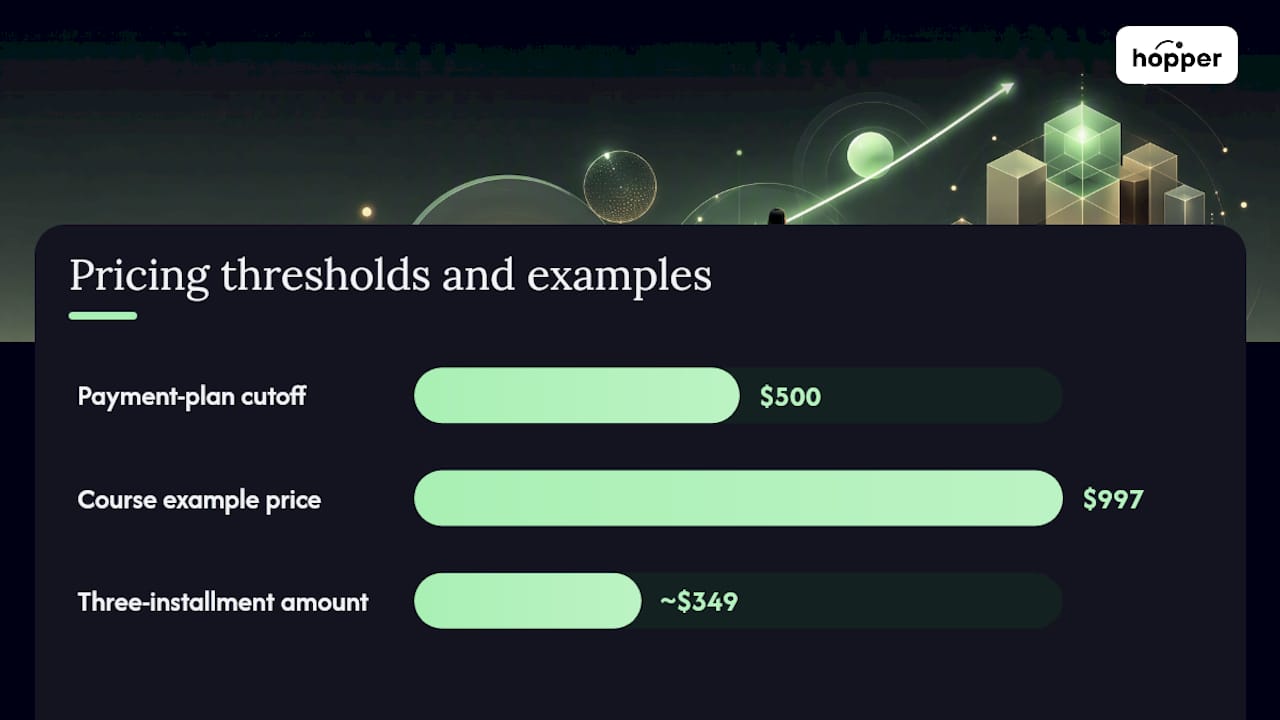
Payment plans deserve a permanent spot in your checkout for anything above $500. Splitting a $997 course into three payments of roughly $349 doesn't just make it "feel" cheaper. It removes a real cash-flow objection for buyers who would say yes but can't front the full amount today.
| Model | Best for | Watch out for |
|---|---|---|
| One-time fee | Defined outcome, self-paced content | Buyers expect it to be "finished" fast |
| Subscription | Ongoing content, active community | Churn if new value stalls |
| Cohort | High-touch coaching, live cohorts | Time-intensive, caps your scale |
| Payment plan | Any offer over $500 | Requires refund/default policy |
What Pricing Framework Should You Use?
Skip cost-plus pricing. It's built for physical goods with a bill of materials, and digital products don't have one. Charging based on "hours I spent recording" ignores the only variable that matters to a buyer: what the course is worth to them.
The framework that holds up across niches is value-based pricing, and the simplest version of it is the 10% rule: price your course at roughly 10% of the credible value the buyer expects to gain. If your course teaches freelancers to land a $5,000 client, a $497 price tag is defensible math, not a guess. If it saves a small-business owner 40 hours a year at a $50 hourly rate, that's $2,000 in value, and a $197 to $297 price point looks cheap by comparison.
Market-based pricing means mapping what similar courses in your niche actually charge, then choosing where you sit relative to that range based on your authority and outcomes. Sweet-spot anchors tend to cluster at $197, $497, and $997, which gives you natural landing points rather than arbitrary numbers like $211 or $438.
Anchoring is where framework meets psychology. Show a $1,997 VIP tier next to your $497 core offer, and the core offer suddenly looks reasonable by comparison, even if nobody buys the VIP tier. That's the anchor doing its job.
- Value-based: price at ~10% of the buyer's expected gain
- Market-based: benchmark three to five competitors, then position above or below based on your proof
- Anchoring: always show your highest tier first on the pricing page
Pro Tip: Before you finalize a price, send a five-question survey to your email list asking what they'd expect to pay for the exact outcome you're promising. The number they guess, not the number you feel comfortable charging, is your real market signal.
How Many Pricing Tiers Should You Offer?
Three. Not one, not five. A single price forces every buyer into the same decision, and you leave money on the table from both the budget-conscious buyer and the one who would gladly pay more for extra access.
The Standard, Plus, VIP template works because each tier serves a distinct psychology, not just a distinct feature list.
- Standard delivers the core transformation. This is your volume tier and should carry the bulk of your enrollments.
- Plus adds direct feedback: group coaching calls, a private community channel, or graded assignments. This is where most of your revenue should concentrate.
- VIP adds scarcity and proximity: 1:1 calls, limited seats, or a done-with-you element. Price it high enough that it feels exclusive, even if few people buy it.
The revenue split usually looks like roughly 50% from Standard, 35% from Plus, and 15% from VIP, which tells you where to spend your design energy: Plus is your workhorse tier.
| Tier | Price example | What it includes |
|---|---|---|
| Standard | $297 | Core video lessons, workbook, lifetime access |
| Plus | $497 | Everything in Standard, plus group coaching calls and community access |
| VIP | $1,997 | Everything in Plus, plus two 1:1 calls and priority feedback |
Notice the jump from Plus to VIP is bigger than Standard to Plus. That's deliberate. It makes Plus look like the obvious middle choice, which is exactly the decoy effect at work.
How Do You Calculate Your Course Revenue Goals?
Work backward from the number you actually need, not the number that sounds exciting. The formula is simple: Revenue Goal ÷ Price = Sales Needed. Then check that sales number against how many people you can realistically reach.
- Set your revenue goal. Say you want $20,000 from your next launch.
- Divide by your price. At $497, that's 41 sales. At $997, it's 21 sales.
- Apply your conversion rate. If your email list converts at 2%, you need 2,050 engaged subscribers to hit 41 sales at $497, or 1,050 to hit 21 sales at $997.
- Check the math against your actual list size. If your list is 800 people, the $997 price point with a 2.6% conversion rate is more realistic than chasing 41 sales at a lower price.
Webinar-driven launches often convert higher than cold email, sometimes in the 5% to 10% range for a warm, engaged audience, while cold paid traffic can fall well under 1%. Run your numbers separately for each channel rather than blending them into one average, because a single bad channel can quietly drag your whole forecast down.
For break-even on paid ads, divide your total ad spend by your price to find the number of sales needed to break even, then compare that to your expected conversion rate from paid traffic. Spending $2,000 on ads to sell a $497 course means you need just over 4 sales to break even, which is a reasonable target even at low conversion rates if your traffic quality is decent.
Run this table with your own numbers before you commit to a price. It takes ten minutes and prevents the most common launch mistake: picking a price that sounds good but mathematically can't hit your goal with the audience you actually have.
How Does Pricing Psychology Affect Course Sales?
A $497 price feels meaningfully cheaper than $500, even though the gap is three dollars. That's charm pricing, and it reliably increases conversions compared to clean round numbers, especially at mid-range price points.
Anchoring works by giving buyers a reference point before they see your real price. Show the VIP tier at $1,997 first, and your $497 Standard tier reads as accessible rather than expensive.
The decoy effect takes anchoring one step further. Price your Plus tier close enough to VIP in value, but far enough below in price, and Plus starts to look like the smart choice. Most buyers aren't comparing your price to zero. They're comparing it to your other tiers.
Scarcity adds real pricing power when it's genuine. Limiting cohort enrollment can be worth 20% to 30% in price compared to an evergreen version of the same offer, because live cohorts have a hard capacity limit that a self-paced course doesn't. The catch: constant "limited time" discounts train your audience to wait you out. Reserve urgency for actual launch windows, not a permanent countdown timer.
- Anchoring: show the highest tier first
- Decoy effect: price your middle tier to make it the obvious pick
- Charm pricing: end prices in 7 or 97, not round numbers
- Scarcity: cap cohort seats for real, not as a marketing trick
Pro Tip: At checkout, replace "Buy Now" with something that restates the outcome, like "Start My 30-Day Turnaround." It's a small copy change that reduces the moment of hesitation right before payment.
How Do You Test and Adjust Your Course Price?
Price testing doesn't require a huge audience, but it does require discipline about what you measure.
- Sales page price test: Run two versions of your sales page with different prices for two to four weeks, splitting traffic evenly. You'll want at least 100 visitors per version before drawing conclusions, since smaller samples produce noise, not signal.
- Checkout presentation test: Keep the price identical but change how it's framed (monthly equivalent vs. full price, with or without a payment plan option) to isolate presentation from price itself.
- Cohort split test: If you run recurring cohorts, price one cohort higher than the last with identical support and content, then compare completion rates and refund requests, not just signups.
Track more than conversion rate. Watch refund rate, completion rate, and referrals, because a price that converts well but produces high refunds is actually losing you money and trust.
- Raise prices gradually, typically every one to two launches, not every week
- Grandfather existing customers at their original price to protect trust
- Announce increases in advance rather than silently changing the number
What Are the Most Common Online Course Pricing Mistakes?
The most expensive mistake is pricing by the clock instead of the outcome. "I spent 40 hours recording this, so it should cost X" ignores the buyer entirely. Charge for the transformation, not your production time.
- Underpricing from imposter syndrome: Fix it by pricing against the buyer's outcome, not your own confidence level.
- Constant discounting: Fix it by reserving discounts for genuine launch windows, since permanent sales quietly train buyers to never pay full price.
- No refund policy, or an unclear one: Fix it by publishing a clear, short policy before launch, not after your first complaint.
- Ignoring delivery format in your price: A cohort with live coaching and a self-paced video library shouldn't share a price tag, even if the topic is identical.
- One price for everyone: A single price point without tiers means budget buyers don't convert and high-intent buyers overpay for less than they wanted.
A course priced at $27 because the creator feared rejection often sees lower completion rates too. Buyers commit less to what costs them less, and a $27 price tag rarely earns the attention a $297 one does.
What Are Realistic Price Ranges by Course Type?
The general benchmarks for course depth hold up well across niches, with adjustments for coaching or community layered on top.
| Course type | Typical price range | Notes |
|---|---|---|
| Mini-course (under 2 hours) | $29 to $79 | Best as a lead-in to a bigger offer |
| Standard course (2 to 10 hours) | $79 to $199 | Most common entry point for new creators |
| Flagship course (10+ hours) | $199 to $499 | Should include a defined outcome and support |
| Cohort program with coaching | $997 to $2,997+ | Justified by live access and completion rates |
| Certification program | $499 to $1,997 | Premium justified by credibility, not just content volume |
That's 36 sales, or roughly $10,700 per launch. Run that launch quarterly and you're looking at over $40,000 a year from one asset, without touching cohort pricing at all.
A business coach running two cohorts a year at $1,997 with 15 seats per cohort, filled at 80% capacity, brings in close to $48,000 annually from just those two cohorts. The math changes fast once you introduce a premium tier.
- Hobbyist buyers respond well to lower mini-course price points and impulse-friendly charm pricing
- Career-focused professionals tolerate higher prices when ROI is framed in income or promotion terms
- B2B buyers expect invoicing, payment terms, and often pay more without blinking if the outcome maps to revenue
How Do You Launch and Communicate a New Course Price?
A price is only as good as the page and policy that support it. Work through this before you open the cart.
- Finalize your sales page copy, making sure the price appears near the outcome, not just near the buy button.
- Set up your payment plan option if your price is above $500.
- Publish a clear refund policy visible before checkout, not buried in the FAQ.
- Draft FAQ answers that pre-address objections about price, time commitment, and support level.
- Build your pre-launch sequence (roughly one to two weeks of value-driven content before cart opens).
- Set your open-cart window, typically five to seven days, with one clear close-cart deadline.
- Plan a post-launch nurture sequence for people who didn't buy, without discounting immediately.
For evergreen sales outside a launch window, revisit your anchors every quarter, review conversion data monthly, and schedule discounts around real calendar events rather than running them constantly.
How Does Your Platform Affect Course Pricing?
Your sticker price and your take-home pay are two different numbers, and the gap between them is entirely determined by your platform's fee structure. A $997 course sold through a platform charging 5% transaction fees plus a $199 monthly tier costs you very differently than the same course sold through a flat-fee tool.

The costs to watch: monthly subscription fees, per-transaction cuts, contact or member caps that force you into a higher tier as you grow, and app access fees that some platforms gate behind their top plan.
Review sites document this friction directly. Creators cite feature gating and per-contact caps as recurring frustrations, and similar complaints about pricing tiers and limits show up across platform reviews. Those caps matter more as your list grows, since a platform that felt affordable at 500 contacts can suddenly cost triple that at 5,000.
| Cost factor | Legacy tiered platforms | Flat all-in-one pricing |
|---|---|---|
| Monthly base fee | Rises with contact count | Flat regardless of scale |
| Transaction fee | Often low single-digit percentages, varies by tier | Can drop to 0% on top tier |
| Contact/member cap | Common, forces upgrades | Typically unlimited |
| Native mobile app | Often gated to top tier | Included at base price |
Pro Tip: Before you raise your course price, check your platform bill first. Sometimes the real fix isn't charging more, it's switching to a flat-fee platform that stops eating your margin as you scale.
What We've Seen Work for Course Creators
Across the pricing patterns we track, three tiers consistently outperform a single price point, cohorts justify their premium when the coaching is real, and price increases tend to convert at similar rates to the old price, as long as the value increase is visible. Creators who've migrated their pricing structure onto a cleaner platform often find the packaging decision gets easier once the fee math stops working against them.
A Simpler Way to Price and Sell Your Course
Every pricing model in this guide, one-time, subscription, cohort, tiered, gets harder to execute when your course host, community tool, and checkout are three separate subscriptions eating into your margin before a single sale closes — tools like best AI tools for course creators can help reduce course delivery cost while boosting productivity. Hopper puts course hosting, community, async coaching, and a built-in storefront in one hub, so the price you set is closer to the price you keep.

Unlimited members, unlimited products, and a native iOS and Android app come standard, not gated behind a premium plan. If you're mapping out a three-tier launch or a cohort price increase, see how the full feature set works or browse creator migration stories from coaches who made the switch.
Sources
- Online Course Pricing Guide: How Much to Charge in 2026
- How Much to Charge for an Online Course in 2026 (Real Pricing Data)
- How to Price a Digital Product (Without Guessing) — Pocketsflow Blog
FAQ
How much should I charge for an online course?
Most creators should charge between $297 and $997 for a self-paced flagship course, and $97 to $2,997 across the full market depending on format, with cohort programs commanding the higher end.
How much does an online course cost to buy?
Buyers typically pay $29 to $79 for mini-courses, $79 to $199 for standard courses, and $499 or more for premium programs that include coaching or community access.
What is the cheapest type of online course?
Mini-courses under two hours are the most affordable format, generally priced between $29 and $79, often used as a lead-in offer before a higher-priced flagship course.
Are online courses still profitable to create in 2026?
Yes. Course creators using value-based pricing and tiered packaging, rather than flat cost-plus pricing, continue to see strong margins, especially when platform fees are flat rather than scaling with growth, which tools like Hopper are built to address.
How many pricing tiers should a course have?
Three tiers, typically labeled Standard, Plus, and VIP, is the most common structure, with the middle tier usually generating the largest share of revenue.
Recommended
On our list and want off? .