
The Community Engagement Ideas That Actually Retain Paying Members
Boost member retention with effective community engagement ideas. Discover simple actions that create meaningful connections and visible wins.
By the Hopper team
A predictable weekly rhythm, a first meaningful action inside 48 hours, and visible member wins drive more retention than any single feature or platform switch. If you build those three things into how your community runs, everything else (Build A Community Organization Website That Engages like challenges, spotlights, live calls) becomes easier to sustain.
Start this week with three moves:
- Post Monday's discussion prompt before 9 AM, tied to one specific outcome members can share.
- Send a personal welcome DM to every new member within their first day, asking one small question.
- Schedule a 20-minute live session and put it on the calendar publicly, even if attendance is small.
Key Takeaways
A weekly content rhythm combined with first-48-hour activation and visible member recognition produces the largest measurable gains in community retention.
| Point | Details |
|---|---|
| Activate members fast | Get every new member to take one specific action within 48 hours of joining. |
| Keep a predictable calendar | Run three to four posts a week, including one recurring live or interactive event. |
| Make wins visible | Use spotlights, wins threads, and titles to raise the social reward of staying active. |
| Intervene early on inactivity | Reach out personally at 14 to 21 days of silence, before members drift toward canceling. |
| Consolidate your systems | Platforms like Hopper combine onboarding, content, and community in one hub, cutting the friction that causes early churn. |
Table of Contents
- Community Engagement Ideas You Can Copy This Week
- Get New Members Active Within Their First 48 Hours
- Build a Weekly Content Rhythm Members Can Set Their Watch By
- Rituals That Create Anticipation Instead of Just Content
- Make Members Feel Seen and Connected to Each Other
- Moderate and Delegate Without Burning Yourself Out
- Win Back Members Before They Cancel
- What to Track Every Month to Know What's Actually Working
- How to Bring Offline and Hybrid Moments Into a Digital Community
- Building an Inclusive Community That Welcomes Every Member
- Choosing the Right Platform and Tech for Engagement
- Keeping Conflict From Poisoning Your Community Culture
- Why Systems Beat Motivation Every Time
- Run Your Community's Systems in One Place With Hopper
- Sources
- FAQ
Community Engagement Ideas You Can Copy This Week
Some of these take five minutes. Others take a Saturday afternoon and a content batch. Pick based on your current bandwidth, not on what looks impressive in a screenshot.
- Weekly discussion prompt. Post the same day, same time, every week. Predictability builds habit faster than novelty does.
- Wins thread. A pinned space where members post progress, however small. This is the single cheapest recognition tool you have.
- 5-day micro-challenge. Low barrier, visible outcome, built-in social proof when members post their results.
- Member spotlight. One member featured every two weeks with a short interview or before/after.
- Guest expert AMA. Higher effort, but it resets energy in a community that's gone quiet.
- Cohort-based sprint. Group a subset of members through a shared four-week goal with check-ins.
- Native mobile push notifications. A simple "new prompt is live" push through your platform's app drives same-day replies that email alone rarely gets.
- Peer accountability pairs. Match two members monthly around a shared goal.
- "Ask me anything" text thread. Async version of a live call for members who can't attend in real time.
- Themed content month. Rotate a monthly focus (mindset, tactics, community) to keep the calendar feeling fresh without extra invention.
- Milestone shoutouts. Automated or manual recognition when a member hits a usage or progress milestone.
Interactive formats like live Q&A and structured discussion consistently outperform static content. Membership research cited by Paprika found interactive communities retain members at very high rates compared to content-only access.
Pro Tip: Batch your prompts and spotlight questions once a month. Write four weeks of Monday prompts in one sitting, and you'll never face a blank content calendar on a Sunday night.
Get New Members Active Within Their First 48 Hours
The first two days determine whether someone becomes an active member or a silent line item on your invoice. A 7-day onboarding sequence gets that first action locked in fast.
- Day 1: Send a quick-start DM with one specific ask ("Reply here with your #1 goal this month") plus a link to orientation content.
- Day 2: Deliver a short "first win" resource. Something they can use in ten minutes, not a 40-minute video.
- Day 3: Prompt a social post: "Introduce yourself and share what brought you here" works better when paired with a concrete question, not left open-ended.
- Day 7: Personally invite them to the next live session by name.
Onboarding built around a first meaningful action within 48 hours can raise long-term retention meaningfully, according to community management research. A generic "introduce yourself" thread gets far fewer replies than a specific question tied to the member's stated goal.
Pro Tip: Write your Day 1 DM once as a template with a merge field for the member's first name and goal. It should read as personal, not automated, even though it's copy-pasted.

Build a Weekly Content Rhythm Members Can Set Their Watch By
Three to four posts a week beats daily posting that burns you out by week three. Consistency, not volume, is what forms the habit.
A sustainable weekly template looks like this:
- Monday: Discussion prompt tied to a specific, answerable question.
- Wednesday: Short teaching post, a tip or framework members can apply same day.
- Friday: Wins recap or lightweight roundup of the week's activity.
- Biweekly: A live session, same day and time every other week.
Rotate a four-week theme (foundations, tactics, mindset, community) underneath that skeleton so returning members always have something to anticipate without you inventing new formats every week. Batch a full month of Wednesday teaching posts in one sitting. Weekly attendance and posting habits correlate directly with retention, since community analyses show members who engage weekly stick around far longer than those who lurk between monthly touchpoints.
Rituals That Create Anticipation Instead of Just Content
The rituals that work share three traits: a low barrier to participate, a visible outcome, and a small social reward for showing up. A micro-challenge, a co-working session, or a "hot seat" call all hit those marks when content-only posts don't.
- 5-day micro-challenge: Members complete a small daily action and post proof. Works because the finish line is close and public.
- Co-working session: A scheduled block where members work alongside each other on camera or in a shared thread. Works because presence alone counts as participation.
- Hot seat call: One member gets focused coaching in front of the group. Works because it's specific, rare, and generates content everyone else learns from.
Repeatable rituals like wins threads and weekly prompts build the kind of visible progress and recognition that community builders consistently point to as a primary retention lever.
Make Members Feel Seen and Connected to Each Other
Recognition and peer connection raise the cost of leaving in a way that extra content never does. A member with a title, a spotlight feature, or an accountability partner has a reason to stay that a video library alone doesn't give them.
- Send a short spotlight request template monthly: three questions, five-minute reply time, feature it the following week.
- Assign contributor titles or badges to active members. Identity markers do more for retention than adding another module.
- Pair members into small accountability pods of two or three, refreshed every 30 to 60 days to keep connections rotating.
- Publicly thank specific members by name in your Friday recap, not a generic "great week everyone."
Member identity, roles, and titles raise the social cost of leaving more effectively than adding content volume, based on retention research on paid communities.
Pro Tip: Keep your spotlight request template to three questions max. Long applications kill response rates, even from your most engaged members.
Moderate and Delegate Without Burning Yourself Out
A simple rubric lets a virtual assistant or community manager run daily moderation while you focus on content and coaching. Three rules cover most situations: no promotion outside designated spaces, respond within a set window, and escalate anything involving conflict or refund requests directly to you.
A VA can typically own welcome messages, content scheduling, comment approval, and a weekly report. What stays with the coach is anything involving money, conflict, or a member who seems close to canceling.
| Task | Who Owns It | Response Time |
|---|---|---|
| Welcome new members | VA | Within the first day |
| Approve posts/comments | VA | Same day |
| Escalate conflict or refund requests | Coach | Within the first day |
| Weekly activity report | VA | Every Monday |
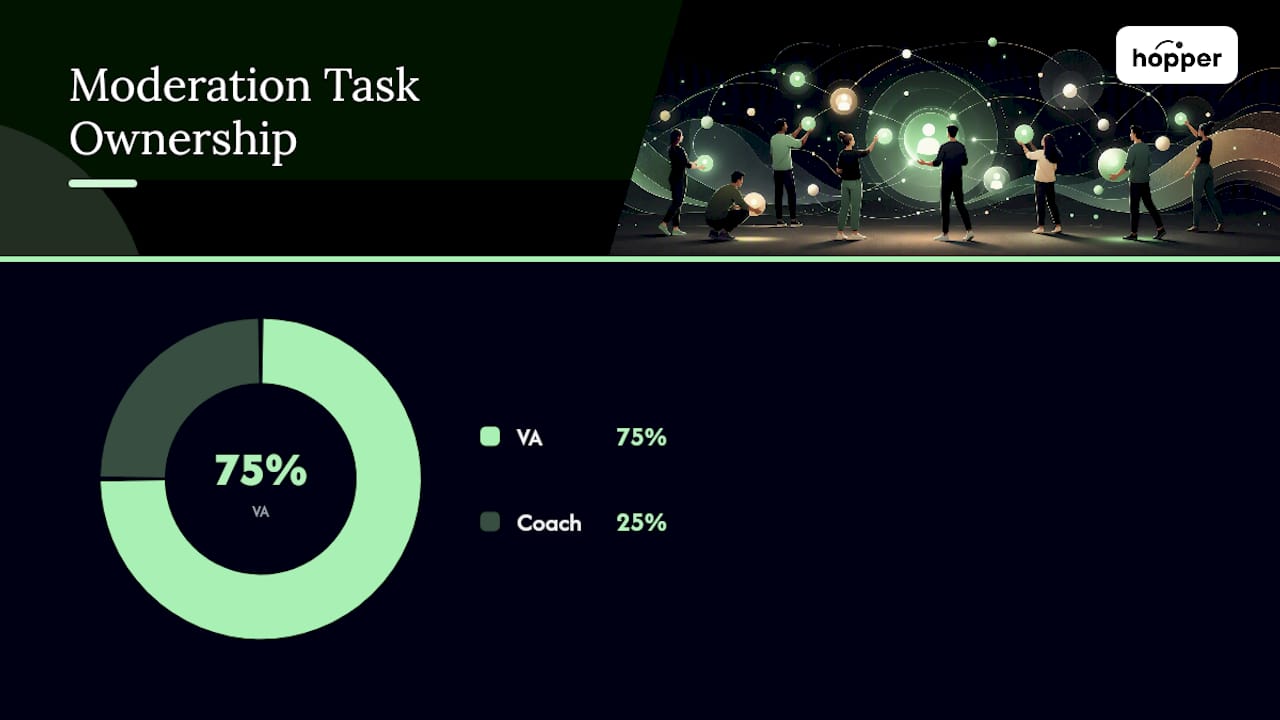
A weekly summary covering new members, active threads, and flagged issues keeps your attention on actual hotspots instead of endless scrolling, and it takes a trained VA under an hour to compile.
Win Back Members Before They Cancel
Inactivity has a predictable window. Members who go quiet for 14 to 21 days are the ones most likely to cancel next, and that's exactly when a personal outreach works best.
- Trigger a check at day 14: a short, personal DM, not an automated blast. "Noticed you've been quiet, everything okay?" outperforms "We miss you!"
- Pair the DM with an invite to a short re-entry challenge, something with a 3 to 5 day finish line.
- Offer a pause option alongside cancel. Members who pause for a month often return; members forced into a binary choice usually just leave.
- Run this sequence consistently rather than only when you notice a cancellation spike.
Personal DMs paired with short challenges recover a meaningful share of drifting members, according to community management guides built specifically around avoiding coach burnout.
What to Track Every Month to Know What's Actually Working
You need five numbers, not a dashboard full of vanity metrics: weekly active members, posts and comments per week, live event attendance, first-48-hour activation rate, and monthly churn.
- If activation is low, the problem is onboarding, not content.
- If posts are steady but attendance is low, the problem is your live format or timing.
- If churn spikes in month one, look at your first 30 days before touching anything else.
Roughly 44% of cancellations in paid memberships happen in the first 90 days, according to membership retention research, which is why the KPIs above weight so heavily toward early activation rather than long-term content volume.
How to Bring Offline and Hybrid Moments Into a Digital Community
Screen fatigue is real for members who spend their workday in video calls already. A digital-only community that never steps offline limits how deep those relationships can go.
Local meetups work when you have geographic density. Even five members in the same metro area meeting for coffee once a quarter creates a bond that outlasts anything posted online. If your community skews global, a hybrid retreat, one or two days a year, gives your most committed members a reason to invest further and often becomes your best source of testimonials and referrals.
Smaller hybrid touches work at any scale. A live session that ends with an optional "stay on camera and work together" block turns a webinar into a co-working session. A regional "meetup thread" where members self-organize dinners at a conference you didn't plan costs you nothing but a pinned post.
The mistake most coaches make is treating offline as an all-or-nothing investment; a full retreat sounds impressive, but a single optional video co-working hour delivers most of the same connection at a fraction of the effort. Start with the smallest hybrid touch that fits your current community size, then scale up only when members ask for more.
Building an Inclusive Community That Welcomes Every Member
A community that feels welcoming to only one type of member quietly shrinks its own ceiling. If your challenges assume everyone has the same schedule, budget, or starting point, you lose people before they ever post.
Vary your prompt language so it doesn't assume a single life situation, income level, or background. A fitness coach whose challenges only reference gym access alienates members working out at home. A business coach whose case studies only feature one demographic signals, even unintentionally, who the community is really for.
Offer multiple ways to participate. Not every member wants to go live on camera; a text-based or async option for the same challenge lets introverted or time-zone-mismatched members contribute fully. Rotate who gets spotlighted so recognition doesn't consistently land on the same handful of vocal members.
Set a simple, visible community standard early, ideally in your onboarding sequence, that names respectful disagreement and discourages exclusionary language without turning it into a legal document nobody reads. The goal isn't a policy binder. It's a tone that tells a new member, explicitly, that they belong here regardless of where they're starting from.
Choosing the Right Platform and Tech for Engagement
The tools you use should reduce friction, not add another login members forget. Every extra app between "I have a thought" and "I posted it" costs you replies.
Meeting members where they already are matters more than most coaches assume. Reducing platform friction, including allowing preferred delivery channels, is one of the highest-leverage levers for cutting churn identified in membership retention research. If your community lives in one tool, your content library in another, and checkout in a third, you're asking members to do work just to stay engaged.
A native mobile app matters more than it sounds. Members who get a push notification about a new prompt reply same-day at rates a weekly email digest rarely matches. If your platform gates its branded app behind a premium tier, or doesn't have one at all, you're relying entirely on members remembering to log into a browser.
Gamification tools, streaks, badges, loyalty pricing, work best when they're visible without being the point. A member who sees their tenure reflected in a lower monthly rate has a quiet, ongoing reason to stay that no content update replicates.
Keeping Conflict From Poisoning Your Community Culture
Every paid community eventually has a disagreement that gets heated in a comment thread. How you handle the first one sets the tone for every one after it.
Address conflict quickly and privately first. Public callouts, even well-intentioned ones, tend to escalate rather than resolve. A short DM to both parties ("Let's take this offline for a second") almost always de-escalates faster than a public moderator comment.
Have one written standard, three sentences is plenty, that you can point to consistently rather than making judgment calls case by case. Consistency matters more than severity; members forgive a firm rule applied evenly far more than they forgive a rule that seems to depend on who's involved.
Give your moderator or VA a clear line for what they can handle alone versus what escalates to you immediately. Refund disputes, harassment, and anything touching a member's reputation should always reach the coach directly, not get resolved by delegated staff. A community that handles its first real conflict well earns more trust than one that never has a rough moment at all.
Why Systems Beat Motivation Every Time
Most coaches treat engagement as a personality problem: be more energetic, post more, show up live more often. That's backward. The communities that retain best run on systems that work whether the coach is having a great week or a terrible one.
Consolidation is part of that system, not a side detail. When onboarding lives in one tool, content in another, and payments in a third, every member touchpoint has a seam where friction creeps in, and every seam is a place a new member quietly disappears. One Hopper user, Daniel Lim, cut $6,000 a year simply by collapsing that stack into a single hub.
The coaches who scale without burning out are the ones who build the operating procedure once and let it run.
Run Your Community's Systems in One Place With Hopper
Everything in this playbook, the onboarding sequence, the weekly rhythm, the moderation rubric, gets harder to execute when it's spread across a course host, a separate community tool, and a checkout page. Hopper puts your Discussions feed, content library, async coaching, and storefront inside one hub, so your Day 1 welcome DM and your Friday wins recap live in the same place your members already check.
The native iOS and Android app comes at the flat rate rather than gated behind a top tier, which matters for exactly the push-notification habit this article recommends. Members and moderators are unlimited on both plans, and loyalty pricing rewards the members you're working hardest to retain by reducing what they pay the longer they stay. If you're running your systems across three or four separate subscriptions right now, Hopper's free migration service moves your existing content and members over without a rebuild. Start a trial and see whether one hub changes how consistently you can actually run this playbook.
Sources
- Manage Coaching Community Without Burnout (3 Simple Systems)
- What Actually Keeps Community Members Paying Month After Month in 2026
- Paprika
FAQ
What is the single best way to increase community engagement?
A predictable weekly content rhythm paired with fast first-48-hour onboarding drives the largest measurable retention gains, according to community retention research.
How often should I post in a paid community?
Three to four posts a week is enough to build habit without burning out the coach, based on membership content strategy research.
When should I reach out to an inactive member?
Reach out personally between day 14 and day 21 of inactivity, since that window is when members are most likely to be considering cancellation.
Can one person run community moderation without burning out?
Yes, with a simple rubric and a VA handling welcomes, scheduling, and weekly reporting, while the coach handles only conflict and refund escalations.
Does switching to an all-in-one platform actually reduce costs?
It can. One Hopper user, Daniel Lim, saved $6,000 a year by consolidating a multi-tool stack into a single platform.
Recommended
On our list and want off? .